Meet the Next Gen Champions: The Future of Governance Is Interdisciplinary
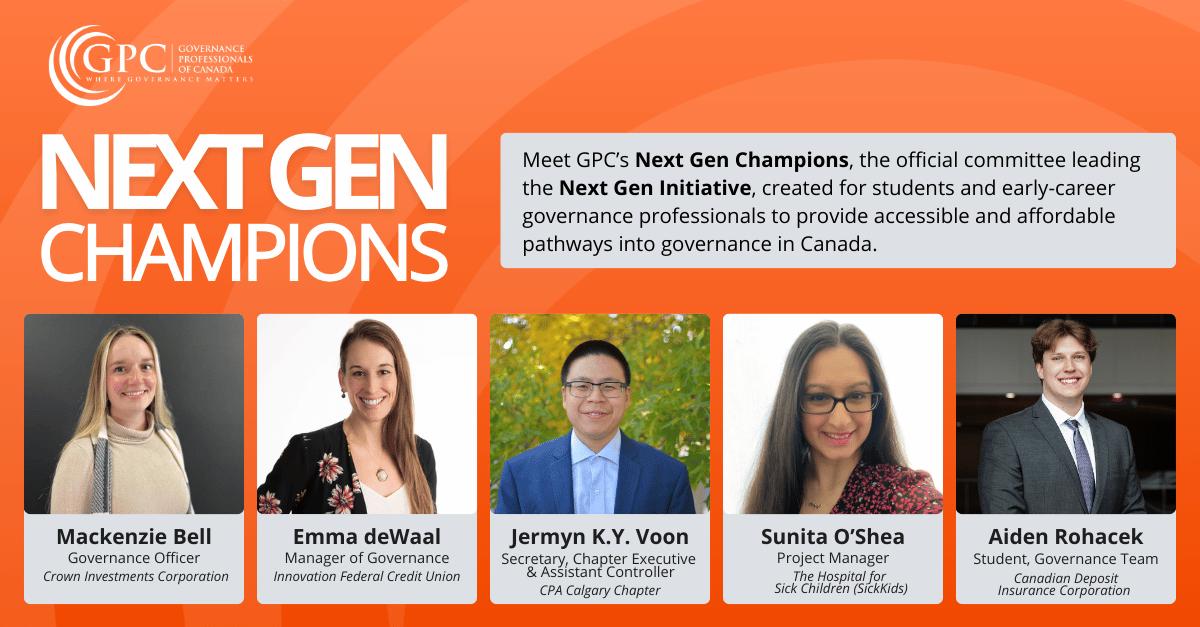
These early career governance professionals represent a wave of leaders who entered the field through curiosity, chance, passion, and purpose.
Mackenzie Bell
Governance Officer, Crown Investments Corporation of Saskatchewan
Mackenzie came into governance almost by accident. Fresh out of a liberal‑arts program—originally planning for law school, then leaning toward policy analysis—she landed in a small industry association where government relations was her primary role.
Supporting the board was secondary, until she was unexpectedly asked to take minutes in her first meeting and found herself captivated by the strategic pulse of the boardroom. She discovered she loved the intersection of risk, strategy, and finance, and the exposure to leaders across sectors.
What keeps her here is the pace: decisions move quickly, no two meetings are alike, and governance demands both structure and adaptability. For students interested in law, policy, AI, operations, business administration, or broader organizational strategy, she believes governance is an ideal fit—an unexpected career that opens more doors than most people realize.
Mackenzie’s advice to fellow Next Gen governance professionals is:
“Communication, influence, relationship‑building—those are the foundational skills in governance. You don’t need to have all the answers on day one; development isn’t linear, and you learn a lot by seeing a full year cycle and how your organization really operates.”
Emma deWaal
Manager of Governance & Corporate Secretary, Innovation Federal Credit Union
Emma entered governance through hands‑on business administrative work—without a university degree or formal legal background—and built her expertise from the ground up. She formalized her governance training later in her career, and today she’s worked in the industry for 10 years and has transformed that practical foundation into a fully realized governance career, now managing governance for a federal credit union where she interprets legislation, advises on board strategy, and shapes organizational decision‑making. Her trajectory shows how governance often rewards those who learn by doing and formalize their training as they grow.
Her career is a powerful reminder:
Experience, curiosity, and mentorship can be just as valuable as formal credentials. Governance affords passionate professionals many opportunities to learn and grow.
She shared the most surprising aspect of governance work is that board members and executives are real people, and they’re not to be feared because typically people that love governance want to share it. She’s been able to have a rewarding career as a governance professional because of her mentors; a lot of them being lawyers. She added that the role is unique in how there’s no typical day in this position, but you always know your contributions are meaningful to the entire organization even if governance isn’t wildly understood.
Emma describes governance as:
“Having the right people make the right decisions at the right time based on the right information—without putting the organization at undue risk.”
She hopes Next Gen becomes a supportive community for early‑career professionals who need a safe place to ask questions and grow.
Jermyn Voon
Assistant Controller, Secretary & Chapter Executive
Jermyn works in business and finance but his passions for governance overlaps into marketing, nonprofit leadership, and arts governance. Although GPC advocates for governance as a profession, Jermyn’s background proves that governance goes beyond a day job, it can fuel passion projects because governance is needed everywhere.
His interest in governance began in university while taking a course on corporate governance which piqued his interest in being involved in non-profit cultural and art boards. That is where he learned the importance of blending governance with his role as an accountant, too.
Jermyn emphasizes that accountants need strong governance education because governance failures lead directly to material misstatements, undetected fraud, and a breakdown of public trust. He took notice of news cases when boards, management, and those in governance roles prioritize their own interests over their oversight responsibilities. Poor governance, he notes, undermines audit quality, misleads shareholders, distorts company valuations, and erodes confidence in financial reporting. For Jermyn, this is why governance literacy is essential in the accounting field, where professionals play a central role in safeguarding institutional integrity.
As a Next Gen Champion, Jermyn advocates for:
- Governance literacy among accountants
- More business expertise in arts organizations
- More diversity in boardrooms
- Greater awareness that every role contributes to governance
Sunita O’Shea
Project Manager, The Hospital for Sick Children (SickKids)
Sunita’s entry into governance was not a career pivot so much as the revelation of a discipline she had been practicing all along. As a project manager in clinical research at SickKids, she spent years orchestrating the highly technical, and often invisible, infrastructure behind every study: aligning ethics reviews, navigating legal and privacy requirements, coordinating with IT and finance, and ensuring research teams have a compliant framework to operate within for the best interests of patients, their families, and clinicians.
It began as operational oversight and grew into a fascination with the structures and accountability that move innovation safely from idea to practice.
Over time, Sunita recognized that her work was not merely administrative efficiency—it was governance in its truest form. Today, she operates in what she calls an “emerging governance space,” shaping the safeguards that will guide the next generation of research and AI‑enabled health care within an AI-driven clinical research program.
Sunita’s goal for the Next Gen initiative:
“My hope is that we demystify governance and create a space where it’s understood at every level, where early‑career professionals recognize it as a dynamic, impactful field that touches every part of the organization.”
Aiden Rohacek
Student, Canadian Deposit Insurance Corporation
Aiden’s governance journey started during his first year of university where he joined the resident association council which is a nonprofit corporation. And, then he became the chair of the student Policy and Constitution Committee he says on a whim. While undergoing internal policy reform he found himself getting lost in writing policies at 7 a.m. meetings because nobody else would. The “aha” moment came when hours of policy drafting felt energizing, not draining.
Now working in governance at a federal Crown corporation as a summer student, he describes governance as:
“The practice of ensuring organizations make decisions in ways that are accountable and transparent.”
Aiden is passionate about youth and student access:
Many students want impact, leadership, and board experience—but don’t know governance exists. He wants to change that.
“I really want to make sure that we're able to break down that barrier and make the career as accessible as it can be to everyone, especially those who are younger and maybe not that senior in their career.”